The allure of a perfectly cooked pizza, with its blistered crust and molten cheese, often conjures images of wood-fired ovens reaching infernal temperatures. Yet, the secret to achieving these culinary masterpieces isn’t just about intense heat; it’s about managing and retaining that heat effectively. At the heart of every high-performing pizza oven lies a crucial, often overlooked component: its insulation. Without proper insulation, precious thermal energy dissipates into the surroundings, leading to longer preheat times, inconsistent cooking temperatures, and wasted fuel. Understanding the science behind pizza oven insulation materials is paramount for any serious pizzaiolo, from the backyard enthusiast to the professional restaurateur.
This comprehensive guide will explore the critical role of insulation in pizza ovens, dissecting the various materials available, their properties, and how to choose the best options for your specific needs. We’ll delve into the thermal characteristics that make a material suitable for the intense environment of a pizza oven, examine the pros and cons of popular choices, and offer practical advice for optimizing your oven’s thermal performance.
By mastering the art of pizza oven insulation, you can unlock a new level of baking consistency and efficiency, transforming your pizza-making experience.
Key Takeaways
- Effective insulation is crucial for pizza ovens to reach and maintain high temperatures, ensuring consistent cooking and fuel efficiency.
- Ceramic fiber blankets are a top choice due to their excellent thermal resistance, low thermal conductivity, and flexibility.
- Calcium silicate boards offer superior compressive strength and durability, making them ideal for hearths and structural components.
- Perlite and vermiculite are lightweight, cost-effective granular materials often used as fill insulation or mixed into refractory cements.
- Refractory cement and mortar are essential for binding insulating layers and creating durable, heat-resistant structures.
- Proper installation and layering of different insulating materials are key to maximizing thermal performance and longevity.
- Consider thermal conductivity (R-value/K-value), temperature rating, density, and durability when selecting insulation materials.

Credit: www.amazon.com
The Science Of Heat Retention In Pizza Ovens
Pizza ovens operate at extremely high temperatures, often exceeding 900°F (482°C), to achieve the characteristic Neapolitan-style crust. Achieving and maintaining these temperatures requires a well-designed thermal envelope. Insulation is the primary means by which this thermal envelope is created, working to minimize heat loss through conduction, convection, and radiation.
Conduction, Convection, And Radiation
- Conduction: This is the transfer of heat through direct contact. In a pizza oven, heat conducts from the hot inner dome and hearth through the oven walls and floor to the cooler outer shell and surrounding environment. Materials with low thermal conductivity are essential to slow this process.
- Convection: This involves heat transfer through the movement of fluids (in this case, air). Hot air currents within the oven can transfer heat to the walls. More significantly, heat can be lost to the surrounding air through convection currents on the oven’s exterior. A well-sealed oven and an effective outer layer help mitigate this.
- Radiation: This is heat transfer via electromagnetic waves. The intense heat inside the oven radiates outwards. While some radiation is necessary for cooking the pizza, excessive radiant heat loss through the oven walls reduces efficiency.
Thermal Conductivity And R-value
The effectiveness of an insulating material is primarily measured by its thermal conductivity, often represented by the ‘K-value’. A lower K-value indicates better insulating properties. Conversely, the R-value measures thermal resistance, with a higher R-value signifying superior insulation. The R-value is calculated by dividing the thickness of the material by its K-value. For pizza ovens, materials with very low K-values (and therefore high R-values per inch of thickness) are highly desirable.
Temperature Ratings And Material Stability
Pizza ovens subject materials to extreme thermal stress. Insulation materials must have a temperature rating significantly higher than the maximum operating temperature of the oven to prevent degradation, melting, or loss of insulating properties. Materials that undergo thermal expansion and contraction without cracking or crumbling are also crucial for long-term durability.
Density And Structural Integrity
While low density often correlates with good insulation (lighter materials tend to trap more air), the insulation must also possess sufficient structural integrity, especially for the hearth and load-bearing elements. Some materials are chosen for their combination of insulating properties and compressive strength.
Top Pizza Oven Insulation Materials
Choosing the right insulation materials is a balancing act between thermal performance, durability, ease of use, and cost. Here are the most common and effective materials used in pizza oven construction:

Credit: www.supremeperlite.com
Ceramic Fiber Blankets
Ceramic fiber blankets, also known as refractory blankets, are arguably the most popular and effective insulation for pizza oven domes. They are made from spun or vacuum-formed ceramic fibers, offering exceptional thermal resistance and very low thermal conductivity.
Properties And Benefits
- Excellent Thermal Resistance: Ceramic fiber blankets can withstand temperatures exceeding 2300°F (1260°C), far surpassing typical pizza oven operating temperatures.
- Low Thermal Conductivity: They possess a very low K-value, meaning they are highly effective at preventing heat transfer. This translates to faster heat-up times and longer heat retention.
- Lightweight: Their low density significantly reduces the structural load on the oven base.
- Flexibility: The blanket form makes them easy to cut, shape, and wrap around curved dome structures, ensuring complete coverage without gaps.
- Thermal Shock Resistance: They can withstand rapid temperature changes without significant damage.
- Chemical Stability: Resistant to most chemicals, though strong acids and alkalis can degrade them.
Applications
Ceramic fiber blankets are primarily used for insulating the dome and crown of the pizza oven. They are typically layered, with multiple blankets providing the necessary thickness for optimal performance. They are often sandwiched between the inner refractory dome and an outer structural layer.
Considerations
- Fiber Dust: When cutting or handling, ceramic fibers can become airborne and are an irritant. Proper personal protective equipment (PPE), including a respirator, gloves, and eye protection, is essential.
- Cost: While highly effective, ceramic fiber blankets can be more expensive than some other insulation options.
- Durability: While resistant to thermal shock, they can be damaged by physical impact or abrasion if not protected by a robust outer shell.
Credit: www.brickwood.info
Calcium Silicate Boards
Calcium silicate boards are rigid, pre-formed insulation panels known for their high strength, durability, and excellent thermal performance at elevated temperatures. They are composed of calcium silicate, reinforced with mineral fibers.
Properties And Benefits
- High Compressive Strength: This makes them ideal for areas that experience significant load, such as under the hearth.
- Excellent Thermal Stability: They maintain their structural integrity and insulating properties at high temperatures, often rated up to 1800°F (982°C) or higher depending on the specific product.
- Low Thermal Conductivity: Offer good resistance to heat transfer, comparable to some ceramic fiber products in certain applications.
- Moisture Resistance: Generally more resistant to moisture than ceramic fiber, although prolonged saturation can affect performance.
- Non-Combustible: They are inorganic and do not burn.
- Ease of Fabrication: Can be cut and shaped using standard woodworking tools.
Applications
Calcium silicate boards are frequently used as:
- Hearth Insulation: Their compressive strength makes them perfect for supporting the weight of the pizza and providing a stable, insulated cooking surface. They are typically laid beneath the firebricks of the hearth.
- Oven Base Insulation: Used to insulate the bottom of the oven, preventing heat loss downwards.
- Outer Casing/Support: Can form a rigid structural layer beneath stucco or other exterior finishes.
Considerations
- Rigidity: Unlike blankets, they are rigid and cannot conform to curved surfaces easily. This makes them less suitable for dome insulation unless cut into smaller pieces or used in conjunction with flexible materials.
- Weight: They are denser and heavier than ceramic fiber blankets.
- Brittleness: While strong, they can be brittle and may chip or break if dropped or subjected to sharp impacts.
Perlite And Vermiculite
Perlite and vermiculite are naturally occurring minerals that are expanded through a heating process. This process creates a lightweight, granular material with excellent insulating properties due to the trapped air within their structure.
Properties And Benefits
- Lightweight: Both perlite and vermiculite are extremely light, adding minimal weight to the oven structure.
- Good Thermal Insulation: They offer good R-values, particularly when used in thicker layers or mixed with binders.
- Cost-Effective: Generally less expensive than ceramic fiber or calcium silicate boards.
- Fireproof: Both are inorganic and non-combustible.
- Versatile: Can be used in various forms, loose-fill, or mixed with refractory cement or binders.
Applications
- Loose-Fill Insulation: Poured around the exterior of the oven dome or base to provide a thick layer of insulation. Often used in conjunction with a protective outer shell.
- Aggregate in Refractory Mixes: Mixed with refractory cement to create lightweight insulating castable materials or mortars. This reduces the overall density and improves the insulating properties of the cement mixture.
- Under-Hearth Insulation: Can be used as a loose fill beneath the hearth slab, though calcium silicate boards are often preferred for their compressive strength.
Considerations
- Lower Temperature Rating (than ceramic fiber): While suitable for pizza ovens, their maximum continuous use temperatures are generally lower than high-grade ceramic fiber blankets. Perlite typically has a higher temperature limit than vermiculite.
- Compressive Strength: Loose-fill perlite and vermiculite have very low compressive strength and cannot support significant weight on their own.
- Dust: Can create dust when handled, requiring appropriate PPE.
- Moisture Absorption: Can absorb moisture if not properly protected, which can reduce insulating performance and potentially cause issues during heating cycles (steam expansion).
Refractory Cement And Mortar
Refractory cement (also known as refractory castable or refractory concrete) and refractory mortar are essential for binding insulating materials, creating structural elements, and providing a durable, heat-resistant finish. They are formulated with special aggregates and binders that allow them to withstand high temperatures.
Properties And Benefits
- High Temperature Resistance: Formulated to withstand temperatures from 2000°F (1093°C) up to 3000°F (1650°C) or more, depending on the specific product.
- Adhesion: Provide strong bonds between refractory bricks, insulating materials, and structural layers.
- Castability/Workability: Refractory cements can be poured or troweled into place, allowing for the creation of custom shapes and monolithic structures. Mortars are designed for joining bricks or applying thin layers.
- Durability: Create hard, abrasion-resistant surfaces once cured and fired.
Applications
- Inner Dome and Hearth: High-duty refractory cement is used to cast the primary cooking dome and hearth floor, providing the direct cooking surface.
- Binding Insulation: Used to create monolithic insulating layers by mixing perlite or vermiculite with the cement.
- Repair: Essential for patching cracks or repairing damaged sections of the oven.
- Outer Shell: Can be used as a structural outer layer, often reinforced with mesh, before applying a final decorative finish.
Considerations
- Curing Process: Refractory materials require a specific curing process, often involving slow drying followed by gradual temperature increases (a “curing schedule”) to drive off all moisture. Improper curing can lead to cracking and failure.
- Density: Standard refractory cements can be dense and have lower insulating properties compared to dedicated insulation materials. Lightweight insulating refractory cements are specifically designed to offer a balance of strength and insulation.
- Cost: High-quality refractory materials can be a significant cost component of oven construction.
Other Insulation Options
While the materials above are the most common, other options exist, often used in specific scenarios or as supplementary insulation.
Vermiculite Concrete
A mixture of vermiculite and Portland cement. It offers better compressive strength than loose vermiculite but has lower insulating properties than pure vermiculite or ceramic fiber. It’s a cost-effective option for insulating the oven base or creating a structural layer.
Rockwool (mineral Wool)
Rockwool is made from molten rock spun into fibers. It offers good thermal and acoustic insulation and is fire-resistant. However, its maximum continuous operating temperature is typically lower than ceramic fiber (around 1400°F / 760°C), making it less suitable for direct contact with the hottest parts of a pizza oven dome. It might be used as an outer layer of insulation in less demanding applications or on the oven base.
Glass Fiber Insulation
Standard fiberglass insulation is not suitable for pizza ovens due to its low-temperature rating (typically around 300-400°F / 150-205°C). It will degrade and lose its effectiveness at pizza oven temperatures.
Designing An Insulated Pizza Oven: Layering Strategies
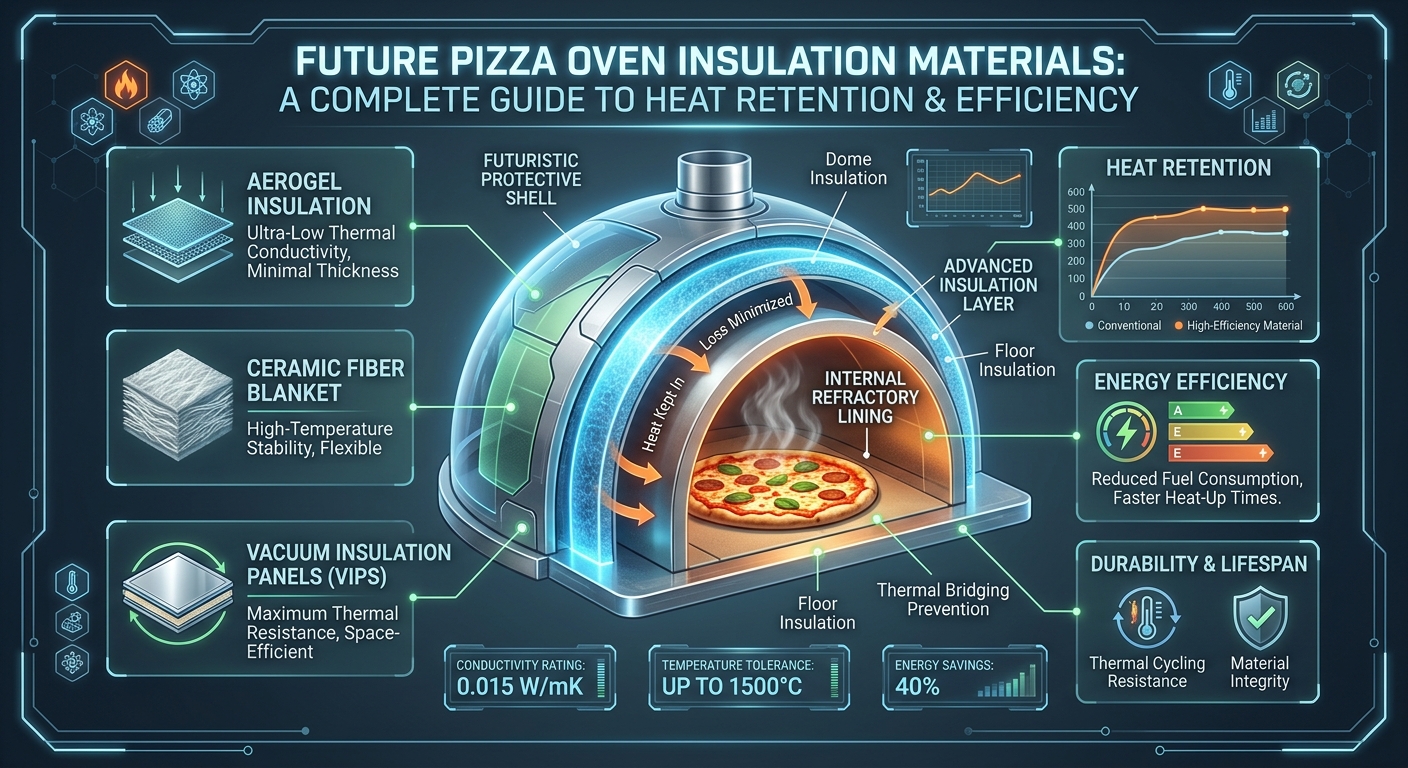
The key to maximizing heat retention and efficiency lies in a well-thought-out layering strategy. Different materials serve different purposes, and combining them effectively creates a robust thermal barrier. A typical high-performance pizza oven insulation system involves multiple layers:
Typical Layering For A Dome Oven
- Inner Dome (Refractory): The first layer, in direct contact with the fire. Made from high-duty refractory bricks or castable refractory cement. This layer absorbs and stores heat.
- Dome Insulation Layer: This is the primary insulating layer. Most commonly, multiple layers of ceramic fiber blanket are wrapped around the inner dome. The thickness is critical; 4-6 inches (10-15 cm) is common for excellent performance.
- Structural Support/Outer Shell: A layer to protect the fragile ceramic fiber and provide a base for the final finish. This could be:
- A layer of insulating refractory cement (often mixed with perlite or vermiculite).
- A layer of calcium silicate board cut to shape.
- A layer of standard concrete or render, sometimes reinforced with wire mesh.
- Final Exterior Finish: Stucco, brick, tile, or stone provide weather protection and aesthetics.
Typical Layering For An Oven Base/hearth
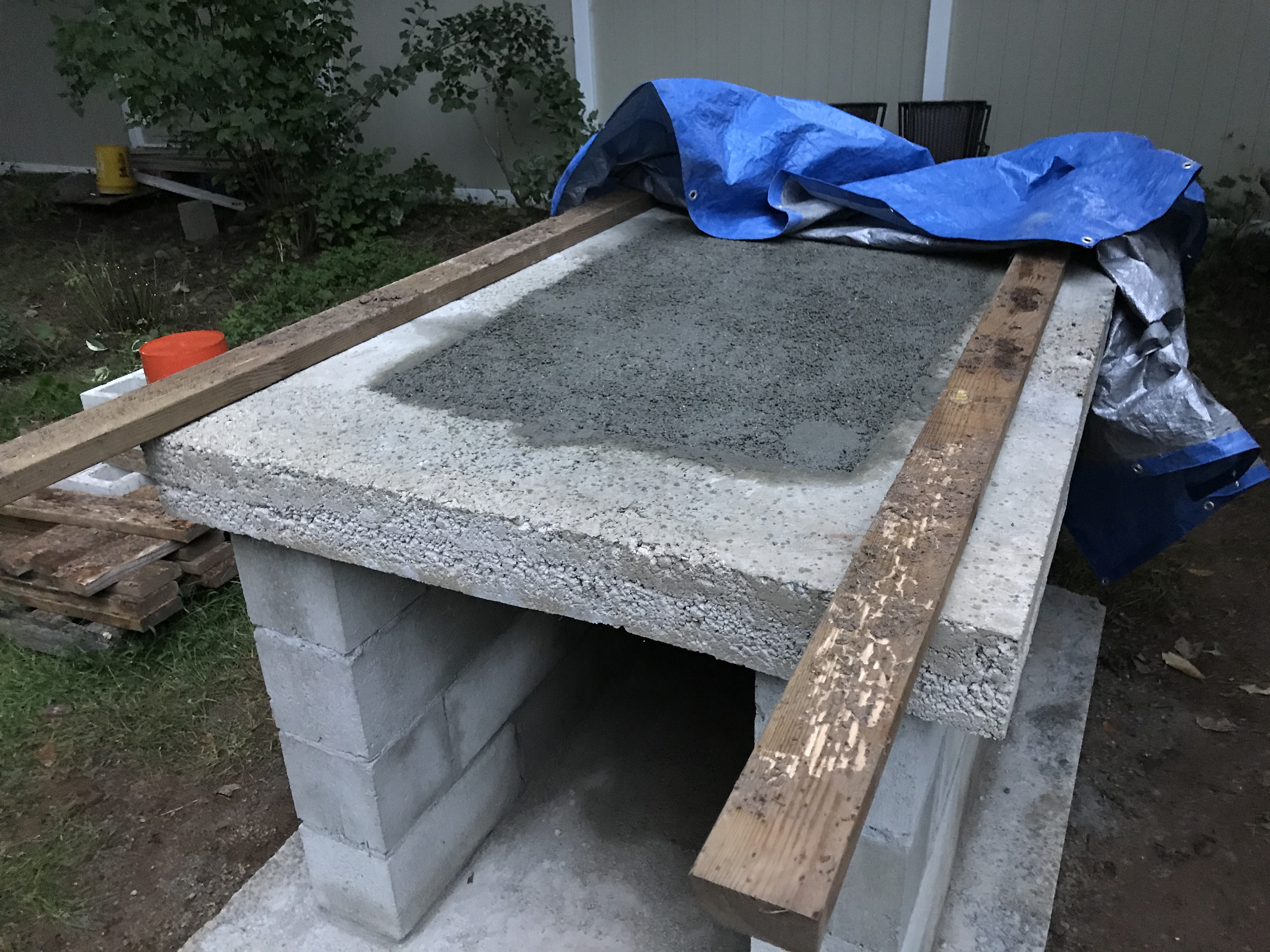
- Oven Floor Slab: A solid base, often concrete block or poured concrete.
- Hearth Insulation: This is critical for keeping the cooking surface hot. Calcium silicate boards are ideal due to their compressive strength and thermal resistance. Alternatively, a thick layer of vermiculite concrete or loose perlite/vermiculite can be used, but requires a robust slab above it.
- Hearth Bricks: Firebricks laid directly on the insulation layer form the cooking surface.
Example: A High-performance Dome Insulation Build
Imagine building a dome oven where the inner dome is cast from refractory cement.
- Layer 1: The cast refractory dome itself.
- Layer 2: Two layers of 2-inch (5 cm) ceramic fiber blanket, totaling 4 inches (10 cm), are wrapped tightly around the dome. The seams of the second layer are offset from the first for better coverage.
- Layer 3: A layer of lightweight insulating refractory cement (mixed with vermiculite) is applied over the ceramic fiber blanket, about 2-3 inches (5-7.5 cm) thick. This layer adds structural integrity and protects the blanket.
- Layer 4: A final coat of render or stucco for weatherproofing and aesthetics.
This multi-layered approach ensures that heat is contained within the oven dome, leading to significantly reduced preheat times and sustained high temperatures for cooking multiple pizzas consecutively.
Factors To Consider When Choosing Insulation
Selecting the right materials involves evaluating several key factors tailored to your specific oven design and usage.
Temperature Rating
This is the most critical factor. Ensure the material’s maximum continuous use temperature significantly exceeds your oven’s peak operating temperature. For pizza ovens reaching 900°F (482°C) or more, insulation should ideally be rated for at least 1800°F (982°C), with ceramic fibers often rated much higher.
Thermal Conductivity (k-value)
Lower K-values mean better insulation. Compare the K-values of different materials at relevant temperatures. Ceramic fiber blankets typically have the lowest K-values, followed by calcium silicate boards and then vermiculite/perlite mixes.
Density And Weight
Consider the overall weight the oven’s foundation needs to support. Lightweight materials like ceramic fiber and perlite/vermiculite reduce structural requirements. Dense materials like standard refractory cement add significant weight.
Durability And Compressive Strength
Where will the insulation be placed? The hearth requires high compressive strength to support the weight of the pizza and the bricks above it. Calcium silicate boards excel here. The dome needs resilience against thermal cycling but less structural load, making ceramic fiber ideal.
Cost And Availability
Budget plays a significant role. Loose-fill perlite and vermiculite are often the cheapest, while high-density ceramic fiber blankets can be the most expensive. Factor in the cost of necessary binders, mortars, and protective outer layers. Availability from local suppliers or online retailers is also a practical consideration.
Ease Of Installation
Some materials are easier to work with than others. Ceramic fiber blankets are flexible and forgiving. Rigid boards require precise cutting. Refractory cements need careful mixing and curing. Consider your DIY skills and the complexity of your oven design.
Moisture Resistance
While pizza ovens are typically shielded from rain, moisture ingress can occur during curing or from ambient humidity. Some materials handle moisture better than others. Ensure any moisture-sensitive insulation is well-protected by a waterproof outer layer.
Comparison Of Insulation Materials
Here’s a simplified comparison to help visualize the trade-offs:
| Feature | Ceramic Fiber Blanket | Calcium Silicate Board | Perlite / Vermiculite (Loose) | Insulating Refractory Cement |
|---|---|---|---|---|
| **Primary Use** | Dome, Crown | Hearth, Base, Structural | Fill, Aggregate | Structural, Binding, Hearth |
| **Max Temp Rating** | Very High (2300°F+) | High (1800°F+) | Moderate (1600-2000°F) | High (2000°F+) |
| **Thermal Conductivity** | Very Low | Low | Moderate | Moderate (lower than others) |
| **Compressive Strength** | Very Low | High | Very Low | Moderate to High |
| **Density** | Very Low | Moderate | Very Low | Low to Moderate |
| **Flexibility** | High | Low | N/A (Granular) | Moderate (Castable) |
| **Cost** | High | Moderate | Low | Moderate |
| **Ease of Install** | Moderate (dust hazard) | Moderate (requires cutting) | Easy (dust hazard) | Moderate (curing critical) |
*Note: Temperature ratings and properties can vary significantly between specific product grades.*
Installation Best Practices And Pitfalls
Even the best materials will underperform if installed incorrectly. Adhering to best practices is crucial for longevity and efficiency.
Key Installation Tips
- Minimize Gaps: Ensure all insulation layers fit snugly against each other and the oven structure. Gaps allow heat to escape via convection and radiation. Overlap seams in blanket insulation.
- Adequate Thickness: Do not skimp on insulation thickness, especially for the dome. The recommended 4-6 inches (10-15 cm) of ceramic fiber blanket is a good target for high-performance ovens.
- Proper Curing: For refractory cements and mortars, follow the manufacturer’s curing instructions precisely. Gradual drying and firing are essential to prevent cracking.
- Protection: Protect insulation layers from direct flame impingement (use firebricks or high-duty refractory) and from the elements (use a durable, weather-resistant outer finish).
- Ventilation: While insulation aims to keep heat *in*, ensure proper ventilation for combustion air and exhaust gases. This is distinct from insulation’s role.
- Use Appropriate PPE: Always wear appropriate safety gear, especially when cutting ceramic fiber or handling dusty materials like perlite and vermiculite.
Common Installation Pitfalls
- Insufficient Insulation Thickness: Leading to long preheat times and poor heat retention.
- Gaps and Voids: Allowing significant heat loss.
- Using Materials with Inadequate Temperature Ratings: Causing insulation to degrade or melt.
- Improper Curing of Refractories: Resulting in cracks and structural failure.
- Exposing Insulation to Weather: Leading to moisture absorption and performance degradation.
- Lack of Structural Support for Hearth Insulation: Causing the hearth bricks to shift or crack under load.
- Forgetting the Hearth Insulation: A common oversight that drastically impacts cooking performance.
Real-world Examples And Case Studies
Observing how different builders approach insulation can provide valuable insights.
Case Study 1: The Backyard Diyer’s Success
John, a home cook passionate about authentic pizza, built his own wood-fired oven using readily available materials. He opted for a castable refractory dome and base

As the author of the “Ultimate Pizza Guide: Recipes, Tips & Secrets Revealed,” I’m dedicated to sharing my love for pizza and empowering others to create delicious homemade pizzas with ease. Join me on a journey to uncover the secrets to perfecting your pizza game!